Rats and mice in Swanson
Swanson has grown by nearly two thirds in five years, and it has done it next to a stream and a forest that already held rats. The two facts belong together.
Start with the people who have been checking. The Predator Free Swanson and Waitākere Township group describes its work in four words on the Alliance directory.
The Predator Free Swanson/Waitākere Township group says "We catch Rats, Stoats and Possums". Its listing is tagged Swanson and Waitākere Township, for baiting and trapping. No counts are given.
Source: Pest Free Waitākere Ranges AllianceSo rats and stoats are a live issue on this side of the Ranges, and the neighbours are the ones doing something about it.
A history on the stream
Project Twin Streams installed bait stations and traps along Swanson Stream and Henderson Creek. At Swanson the first check caught only 5 possums, rising to 58 possums, with several rats also caught. Henderson Creek reached 68 possums.
Source: Project Twin Streams, 17 April 2013That is a 2013 record, so it is history and not a current count. It does show how animals travel: along the stream corridor, from the bush to the edge of the houses. Council open data describes Swanson as 1,613 ha with 693 ha in a Significant Ecological Area overlay, 110 ha of flood plain and 49.4 km of permanent stream (measured 17 November 2026, boundaries generalised).
Growth on cleared ground
According to Wikipedia, Swanson had 3,696 residents in 1,116 dwellings in 2023, up 1,455 people, or 64.9%, since 2018, in a valley northeast of the Ranges that is a major catchment for the stream.
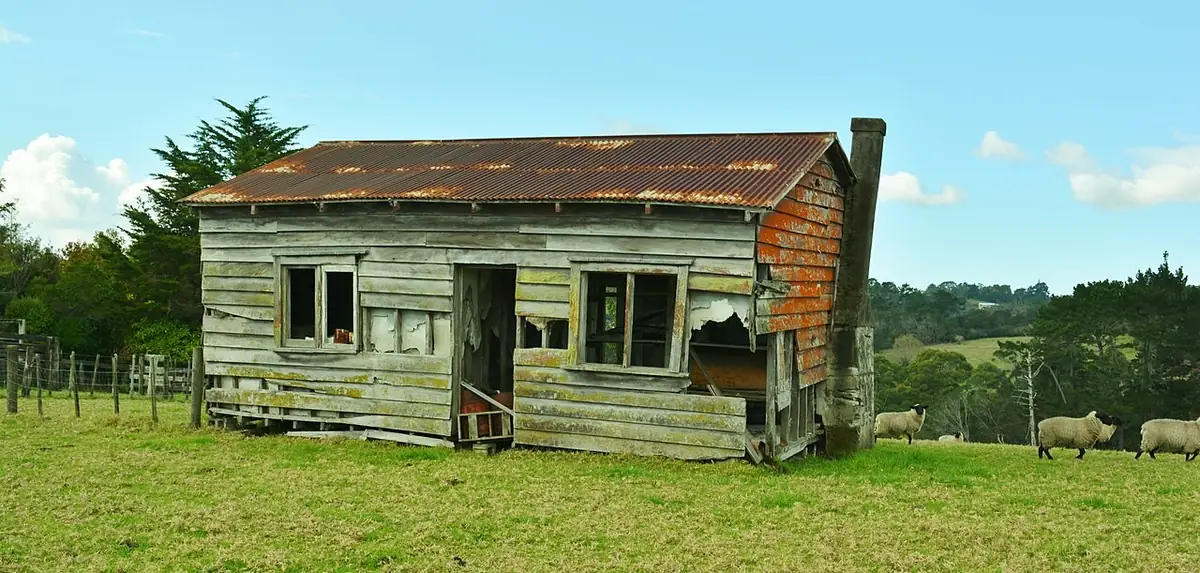
Our reading: new houses on cleared land beside bush and water are the classic setting for rodent callouts. Construction disturbs ground and drives animals toward the nearest shelter. Then the house itself arrives with small gaps around pipes, cable entries and the junction of roof and wall, plus a bare section where the planting has not yet grown. In a recent build, these are the places to check:
- penetrations in the exterior wall where plumbing or electrical lines pass through;
- the cavity beneath a deck or step that no one has closed in;
- garage door seals, which on newer houses are often the weak spot;
- the stormwater edge or a retaining wall that makes a sheltered runway beside the house.
The Department of Conservation describes the ship rat as a good climber found in lowland forest, so a bush-edge house will also see them in the roof. See rats in the roof space.
Settled houses and new ones
An older Swanson property has the usual mix of garden sheds and established trees. A new one has few trees, but has open land next door and a house with no history of a rodent problem, so nobody expects it. In both cases the technician's first job is to find how animals are getting in. Treatment follows, then proofing. The wider group of homes in this position is covered on new-build estates and bush-edge homes.
Cost
For a standard house, published Auckland sources give about $199 to $300, and large properties or severe cases up to $1,000 or more (checked 17 November 2026). A written quote follows the inspection. See the price guide for rats and mice for the sources.
During and after construction
If a house or a neighbouring section is still being built, ask the builder to keep food waste off site and to close service gaps before the cladding is finished. After you move in, walk the outside once a season. Look at the base of walls and the garage door seal for fresh droppings or burrows, particularly after dry weather, when animals move to find shelter. Early signs are far cheaper to deal with than a nest.
Does a new house still need proofing?
Often more than you expect. New houses have fewer defects but more raw edges, and builders do not always seal every gap.
Should I borrow traps from the local group?
It helps if you want to trap. For noises in the roof or walls, an inspection finds out what is going on.
Call or write
The Swanson page gives the suburb overview. For the general rodent process, see rats and mice in West Auckland. To book, ring 09 872 7624, where an assistant takes your details for a specialist callback, or use the callback form.
Sources for this page
Where a source describes the place rather than pests, the pest relevance is our own reading.