German and Asian paper wasps in West Auckland
Two social wasps that look alike and nest differently. How to tell them apart and why it changes the job.
Published
In this note
Yellow and black, buzzing around the deck, and apparently angry. Most people ring about "a wasp" and leave it there. But the two groups that do the damage in West Auckland behave very differently, and the difference decides whether the job is a ten-minute spray or a careful dusting at dusk.
This note is about telling them apart from a safe distance, what each is likely to do near a home and what that means for treatment. The overview of the whole subject is on the wasps in West Auckland page.
The German and common wasps
These two are close cousins and are usually dealt with together. They are stocky, about the width of a pencil, with a bright yellow and black banded abdomen. They fly fast and direct and tuck their legs up under the body.
The Department of Conservation says New Zealand has some of the highest densities of German and common wasps in the world, because they have no natural predators here, winters are mild and food is plentiful. German wasps arrived in the 1940s.
DOC says German and common wasp colonies are normally about the size of a soccer ball but can become huge if they survive winter.
Source: Department of ConservationTheir nests are paper, grey and layered like a scrunched cardboard ball, but you rarely see them. They hide in soil, wall cavities, roof voids and under decks. What you notice is traffic: dozens of wasps flying to a single hole. That is the sign that matters.
The Asian and Australian paper wasps
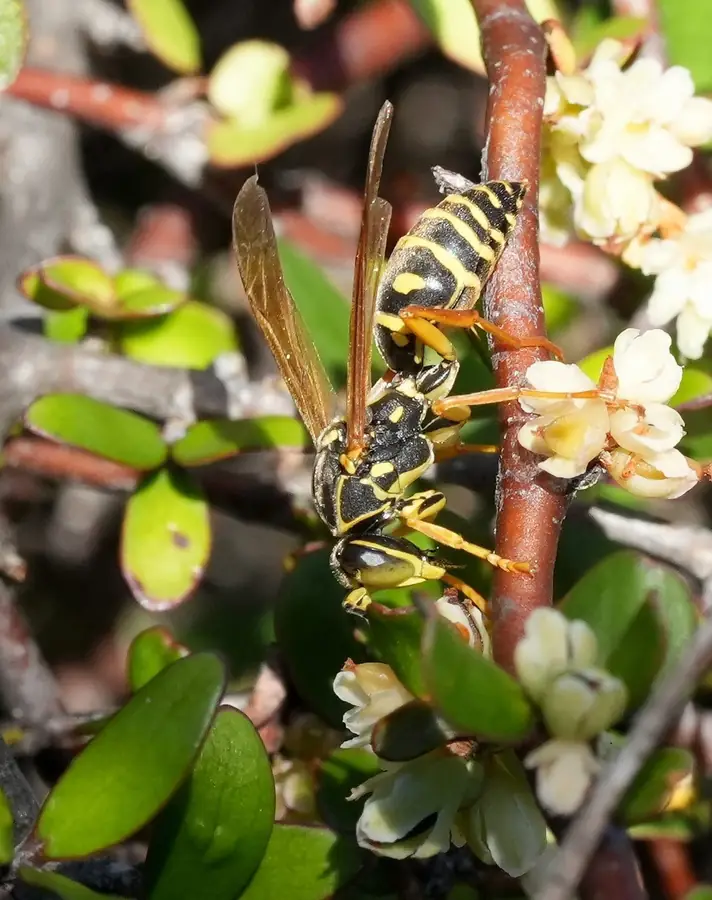
Paper wasps are slimmer, with a narrow waist and long legs that trail beneath the body in flight. The colour is more orange-brown than bright yellow. They fly slowly and look almost lazy.
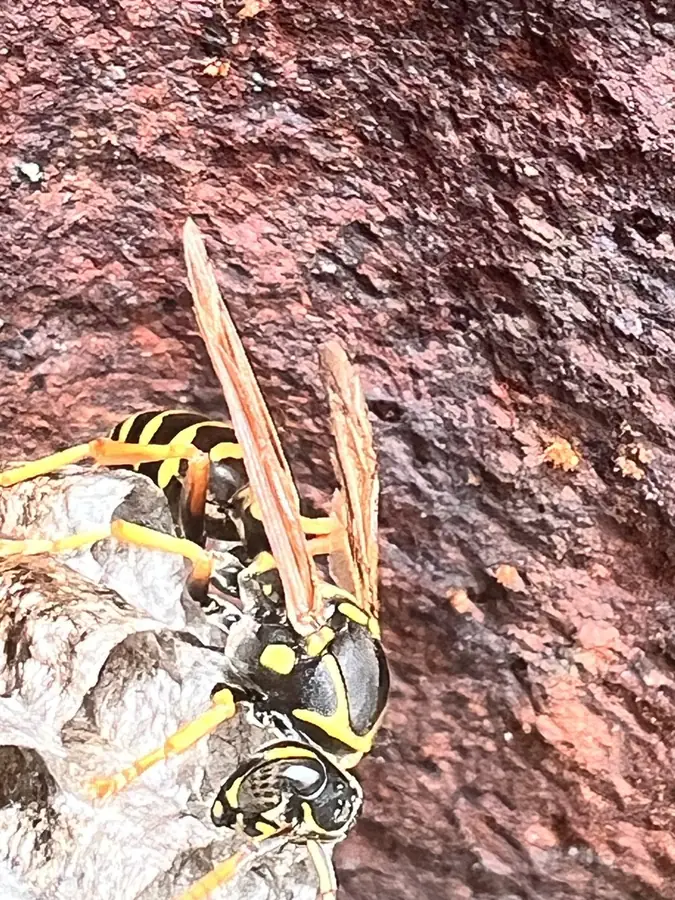
Their nests are very different. A paper wasp builds an open comb of papery cells, with no outer wrapping, hanging from a short stalk under an eave, on a fence rail or in a shrub. Northland Regional Council says the Asian paper wasp arrived in the late 1970s, often builds above ground on houses and other buildings and can reach densities of more than 200 nests per hectare. DOC puts the nest at about the size of a pear.
The council describes the Asian paper wasp nest as typically above ground on buildings, in trees and in bushes.
Source: Northland Regional Council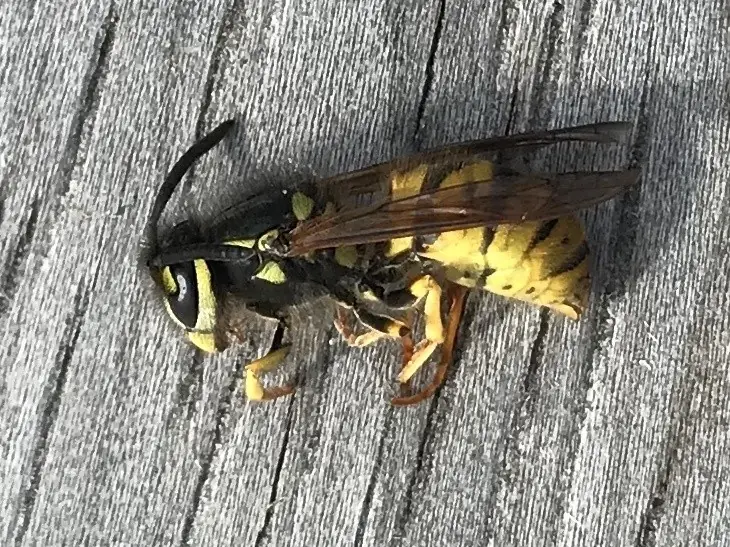
A quick way to tell them apart
| German and common | Asian and Australian paper | |
|---|---|---|
| Body | Stocky, bright yellow and black bands | Slim, orange-brown, narrow waist |
| Flight | Fast and direct, legs tucked | Slow, long legs dangling |
| Nest | Closed paper ball, hidden | Open comb, usually in plain view |
| Where | Ground, walls, roof voids, subfloors | Eaves, fences, shrubs, pergolas |
| Peak | Late summer and autumn | Summer into autumn |
You will not always be sure from a quick glance. That is fine: a photo and a description of where they go is enough for a specialist to decide.
How the difference changes the job
A visible paper wasp comb can often be treated directly in one visit. The technician sprays the comb from a safe distance at dusk and, once the wasps have died, takes it down.
A German or common wasp nest is a different proposition. The technician finds the entrance and applies a product there at dusk or dawn. Workers carry it into the nest, and the colony fails over hours to a couple of days. Cavities cannot be opened casually, and the nest is left in place. Ground nests involve their own cautions, set out on the ground nests page. Wasp nest removal covers the above-ground side.
Behaviour around people
German and common wasps are food robbers at barbecues, drink cans and ripe fruit, and fiercely defensive at the nest. A mower on a ground nest is the classic disaster.
Paper wasps are less interested in your lunch but will defend a comb that is within a metre or so, particularly when it is by a door, clothes line or letterbox. Many people get stung putting out the washing.
Both sting repeatedly. If someone has swelling of the face or throat or trouble breathing after a sting, call 111.
What this looks like in West Auckland
The mix varies by area. Our reading is that open combs are common in suburbs with lots of timber fences, hedges and shrubs, from Te Atatū to Henderson. The Harbourview-Orangihina Park restoration plan, for example, says introduced wasps have no natural predators in New Zealand and that paper wasps can reach high densities in wetland areas, with mild winters and warm springs favouring higher numbers.
For bush-edge and rural suburbs the picture shifts towards the large hidden nests. Pest Free Piha says its wasp programme targets German and common wasps, not paper wasps, and has 476 bait stations installed across Piha. See Piha and Karekare for how that affects households. Orchard land at Oratia and vine country at Kumeū draw in German and common wasps at fruiting time.
Why identification matters before you act
If you disturb a hidden nest while trying to find out what it is, you may meet a lot of angry wasps. So the safe course is: watch, photograph, note the time of day, stay back and ring.
Useful details for the callback:
- Where exactly the wasps are entering or hanging.
- A photo of a wasp on a surface or on the comb.
- Whether the nest is within 3 metres of a door, play area or washing line.
- Whether anyone has ever reacted badly to a sting.
Price and timing
An accessible paper wasp comb is at the low end of the ranges we quote on the wasp price guide, which are estimates from public sources checked on 17 November 2026 and not specific to West Auckland. Hidden nests in roofs and walls are at the higher end. The sooner you act, the smaller the colony.
The timing question has its own note: why wasps peak in summer and autumn.
Are paper wasps less dangerous than German wasps?
They are less aggressive away from the nest and the nests are smaller, but a sting is still painful and still dangerous to someone allergic. Treat both with respect.
Can I knock down a small paper wasp comb?
Do not knock it down. Wasps near the comb will be alerted. A technician can treat it at dusk and take it away.
Do both kinds come back to the same place?
A new queen may choose the same sheltered site the next spring. Sealing gaps and clearing old nests helps.
Ring about a nest
Call 09 872 7624 and an assistant records the details for a specialist callback, or book a callback. You can read more about how we work on the the main page homepage.
Call 09 872 7624, or book a callback and a specialist will ring you.
Call now Book a callback